A First Walk Through a New Neighborhood
A first walk through a new neighborhood helps you spot where sidewalks, crossings, and destinations connect—and where a route needs a closer look.
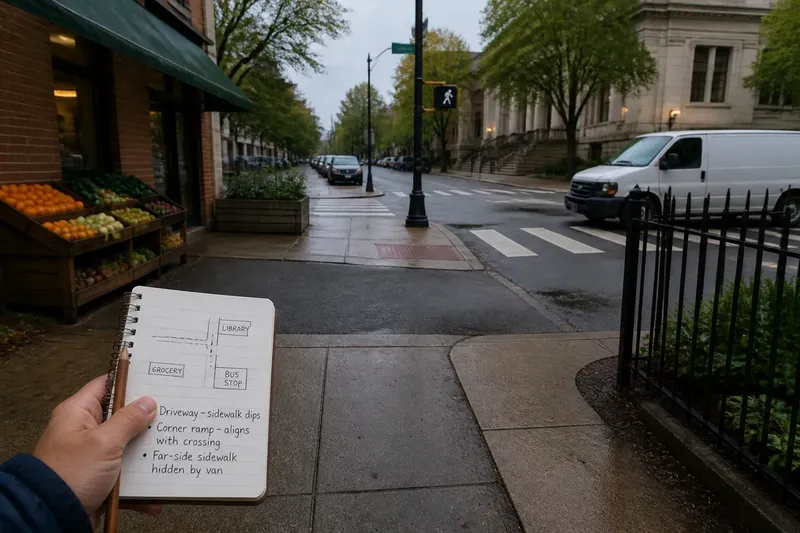
Where does a route stop making sense when you walk it for the first time? A first walk through a new neighborhood can show where the public path changes, narrows, or seems to end. Choose one destination, such as a library or grocery store, and pay attention to the ground beneath your feet rather than trying to rate the whole area.
One outing captures only a particular moment, shaped by light, weather, and activity. Treat what you notice as field notes, not a verdict. The useful question is specific: what happened at this corner, curb, or driveway?
Choose one destination
Pick somewhere that gives your walk a clear endpoint: a bus stop, library entrance, or public garden gate. Before leaving, write down one thing you want to find out. For example, does the sidewalk continue past the busy road shown on your map?
Keep the route loose enough to notice changes in the surface and width of the walking space. If you reach a dead end or a gate, do not assume that a nearby driveway is a public route. Turn back or use a clearly public sidewalk.
A phone map can help you choose a starting point. Once you are walking, check it only when useful; the route itself will show where paths join, break, or change character.
Notice walking surfaces
Pay attention to the condition and continuity of the walking surface. A smooth sidewalk may shift to uneven paving at a driveway, or end where a property boundary begins. Note the exact transition and whether a public path continues beyond it.
At a curb, look for a ramp that connects the sidewalk to the crossing, and note whether its direction lines up with the marked route. You are recording visible features, not conducting a technical safety or accessibility inspection. Avoid entering traffic or stepping around a barrier to investigate.
Imagine you start at a corner grocery store and plan to walk to a library two blocks away. At the first driveway, the sidewalk surface dips; at the next corner, a ramp points toward the crossing, but the far-side sidewalk is hidden by a parked van. You note both locations, follow the marked public route, and find a continuous sidewalk beyond the corner. The result is a precise question for a later visit: can the far-side connection be seen when the van is gone?
Track route breaks
Some changes are easy to miss until you reach them. Look for sidewalk sections interrupted by construction barriers, driveway cuts, fences, or a path that ends at a building wall. Record where the interruption starts and what public route remains available.
At intersections, note how the walking path meets the crossing and continues on the other side. A marked crossing may lead to a sidewalk that bends behind a planted strip, for instance. Describe the sequence rather than calling the whole route “confusing.”
If a path appears to continue through private property, do not cross a gate or posted boundary to check. Mark the point where public access becomes uncertain and leave the question open.
Record useful observations
A pocket notebook or phone note is enough. For each detail, include the location, what you saw, and what decision it prompts. These checks keep the notes concrete:
- Observe whether the sidewalk continues beyond a driveway; if it does, follow the public path, but if it ends, turn back and note where continuity stops.
- Observe whether a curb ramp meets the marked crossing; if it does, note the connection, but if it does not, record the mismatch without stepping into traffic.
- Observe whether a barrier blocks the walking route; if a clearly marked public detour is available, follow it, but if none is visible, stop and note the location.
- Observe whether the far-side sidewalk is visible from the crossing; if it is, note where it continues, but if it is obscured, record what blocks the view and revisit only from a safe public spot.
- Observe whether the route enters a gate or posted private area; if public access is clearly indicated, continue, but if access is uncertain, do not enter and choose a known public route.
- Observe whether construction changes the usual path; if signs identify a public detour, follow it, but if directions are missing or unclear, turn back rather than improvise through a work area.
Keep observation separate from inference. “The sidewalk ends beside the fence” describes what you saw; “the neighborhood has no accessible route” reaches beyond one walk. If you take a photo, frame the pavement or crossing rather than strangers or private information.
What should a first walk answer?
How much should I walk?
Choose a short route that leaves time to stop and look. One destination and a few connected blocks are enough to notice where the walking path changes.
Should I use a map?
Use a map to choose a starting point or confirm a street name, then compare its route with the public path on the ground. If the two differ, note where they part company rather than assuming the map or street tells the whole story.
What should I do at a blocked path?
Stop before entering traffic, a work zone, or a space that may be private. Look for a clearly marked public detour; if none is visible, return by the route you know and record the obstruction.
Can one walk assess accessibility?
No single casual walk can establish how a route works for everyone or in every condition. Record visible features and unanswered questions, then seek additional perspectives before making broader claims.
Plan a return visit
When you get home, mark the one or two route breaks that still need clarification. A later walk may offer a different view of a crossing or show whether temporary construction has changed. If the question concerns a feature hidden from one direction, approach from the other end of the public route.
A first walk through a new neighborhood is most useful when it leaves you with a precise next question, such as whether a sidewalk continues beyond a driveway. Keep that question tied to the place you observed; it will make any follow-up more focused and easier to describe.